

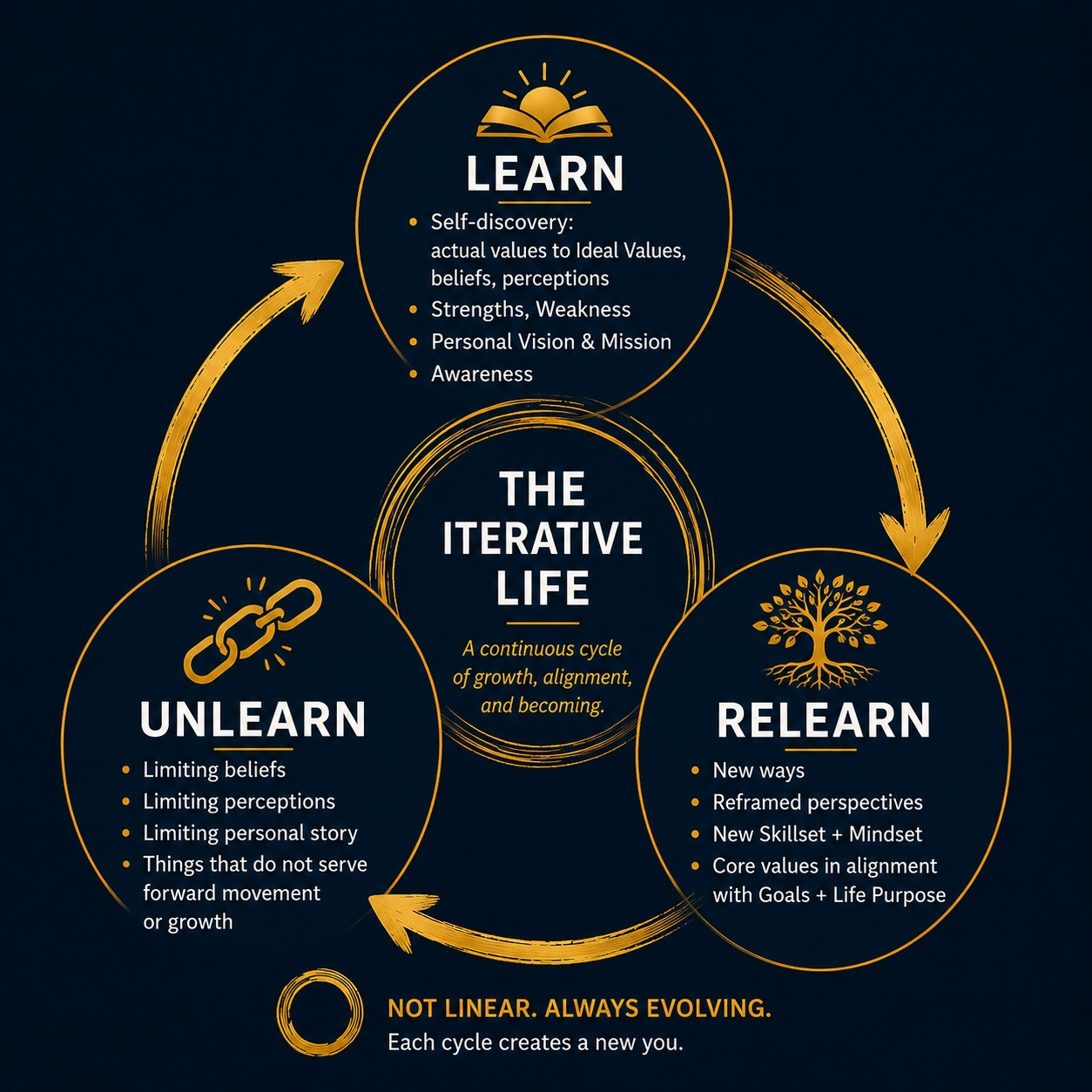
Always becoming. By design.
Alvin Toffler once wrote:
“The illiterate of the 21st century will not be those who cannot read and write but those who cannot learn, unlearn, and relearn.”
I think Toffler was speaking primarily about adaptation in an economic sense—skills, work, staying useful in a fast-changing world. But the more I sit with it, the more I see a frame that’s useful far beyond work. Especially for solo brothas over 50.

Somewhere around that 50th birthday, the internal shift happens. Career strategy (not to be confused with work) starts to give way to a quieter question: What’s next? The old model says retirement. Unlearning means letting go of that script and thinking instead about reinvention. How do I actually want to live the next part of my life?
A “relearn”—the contemplation beyond the inherited script, default timeline, and old agreement of work until 65, slow down, settle into routine, fade quietly into comfort and predictability.
For the solo 50+ brotha—at this current moment in history—who’s taken care of himself mentally and physically, there is an opportunity for something more instinctive. Something more expansive. More intentional.

No partner’s script to negotiate or perform for. Just you and the quiet.
More aligned with:
health,
peace
freedom,
creativity,
purpose,
travel,
solitude,
community,
or simply having enough space to finally hear yourself think.
This unlearning/relearning phase might come with a degree of tension depending on your orientation.
The rational life—culture’s definition
Some of us spent years inside institutions, corporations—often one company, because movement in corporate America wasn’t a luxury for brothas. Not without a unique kind of risk.
Others spent their whole career trying to avoid that “rational life.” Not everyone was built for office culture, institutional hierarchy, or repetitive systems.
Either way, there can come a point where the structure no longer fits the person who once needed it.
That rational life—roles, titles, intellectual structures, the socially accepted routine—can start to feel like a disconnect. That unsettling restlessness you used to suppress every time it rose to the surface.
At 50, you start mentally composing your memoirs.
You question the unspoken deal: security is worth whatever part of yourself you traded for it. Comfort. Acceptance. Validation. Doing what everyone else did. The same script.

The commute. The meetings. The corporate language—deliverables, SMART goals, Q3 alignment. You look around the room and see people genuinely concerned about a spreadsheet. Or worse: after hours, the same people are still talking shop.
Something shifts. A slow internal pressure crosses a threshold. Whatever you suppressed won’t stay down anymore. Your ears just stopped being able to process the frequency of organizational rhetoric. The soul—whatever woke up—is now in conflict. Rejecting it.
That inability to keep performing? That’s your true self trying to emerge. And the voice has gotten louder.
Reinvention and Institutional Thinking
If you’ve spent years as an “establishmentarian”, or as William H. Whyte termed it, “Organization Man,” institutional thinking shapes you over time. Eventually, people lose trust in their own instincts and intuition. That very thing the “rational life” tries to silence.
And it’s not just work. Work is so central that the dissatisfaction seeps everywhere. Social life starts to feel predictable. Same watering holes. Same stories.
Many people try to reinvent themselves without purging the strict institutional thinking and end up still searching for:
a program
a formula
a guaranteed path
a step-by-step system
another externally approved script

You can’t build a new life clinging to the blueprint of the old one. GBM isn’t about a blueprint. The process is individual and personal, a deeper shift: becoming comfortable with self-direction.
When you’re solo, there’s no partner to catch you—but also no one to confuse your voice with theirs.

So maybe that’s what Toffler’s line really touches. The willingness to let the mind stay open enough to change. Not just updating the software—a whole new operating system.
Adaptability. Elasticity.
The brain adapts to repeated patterns. What we practice becomes familiar. You move from needing discipline to being habitual. Learn something new, and the brain changes. That also keeps you young.
This applies to thought patterns too.
Identity (which attaches to repetition).
Fear.
Possibility.
Worldviews.
Often, the resistance is from the people around us. You tell someone your plans, and if they don’t immediately start defending their choice, the questions start: How? What’s the timeline?
The ego craves control. Reasonable questions to be sure. But sometimes those questions come from fear disguised as logic. And, most of the time, you can’t answer them; sometimes you don’t know step 3 until you’ve taken step 1. Those conversions end up draining your energy.
And then there’s the hardest part, that internal voice—the familiar voice, the conditioned one that wants certainty before movement. To give up who you’ve been is frightening.

I recently heard this definition of fear:
“Fear is a self-created feeling based on the pseudo-realization that one doesn’t have the capacity to overcome a perceived experience.”
Being solo means no one’s there to call your bluff. So you have to call your own.
You’ve learned. Now it’s time to unlearn. Then relearn.
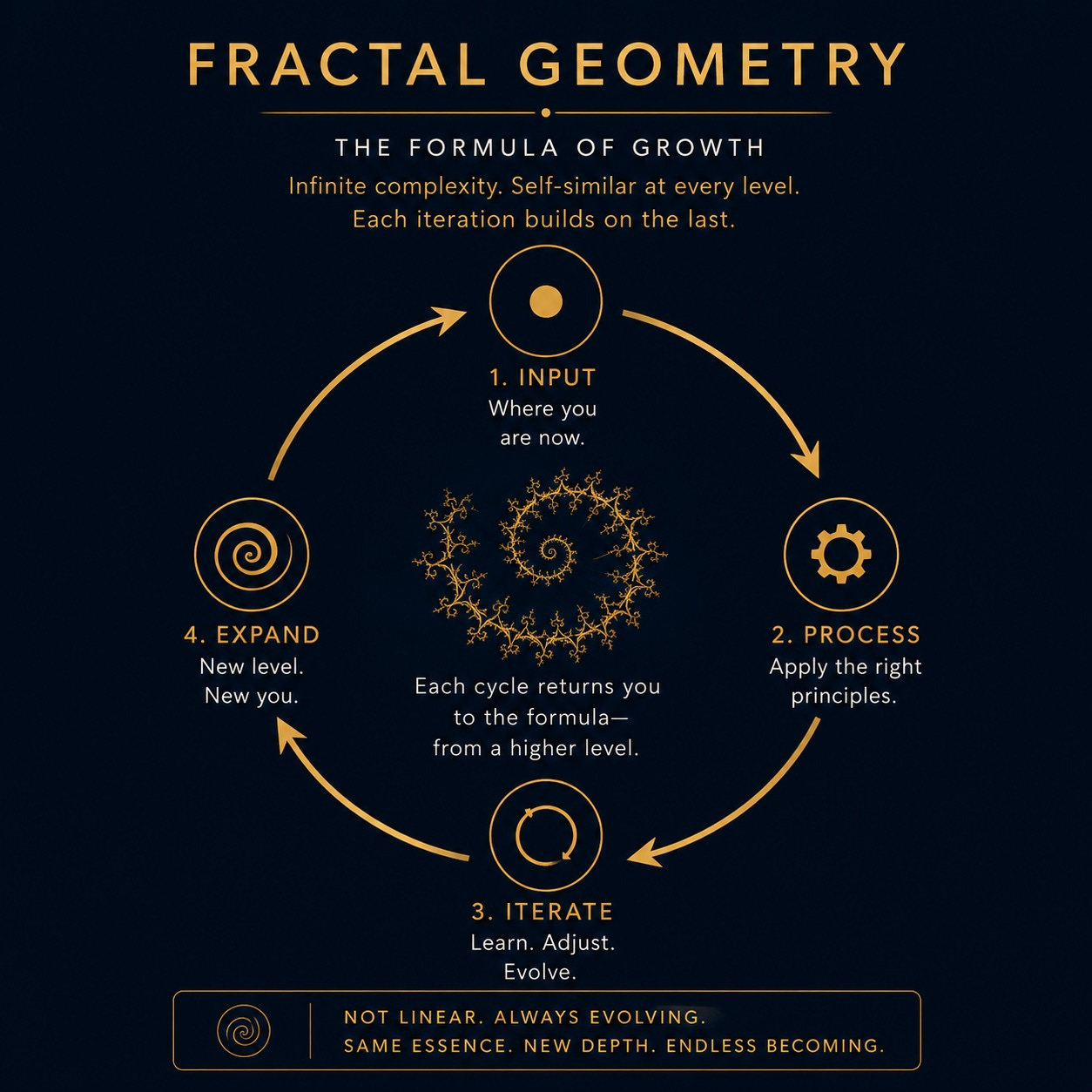
Here’s an allegory: fractal geometry. You solve the equation and get an answer. Feed it back into the same equation. Solve it again. Feed that answer back. Same pattern, same formula—over and over.
That’s why I keep coming back to the idea of iteration. You solve for one version of yourself. Life changes. Experience changes you. Awareness changes you.
Then you keep returning to the process from a different level of understanding. And the cycle continues. Like seasons.
So I’ll leave with this—especially for the solo 50+ brothas:
What’s one thing you’ve learned that you now need to unlearn? Not theoretically. Actually.
And where are you in this cycle? Still performing? Quietly quitting? Or already building something new—on your own terms?